54
African countries
tracked

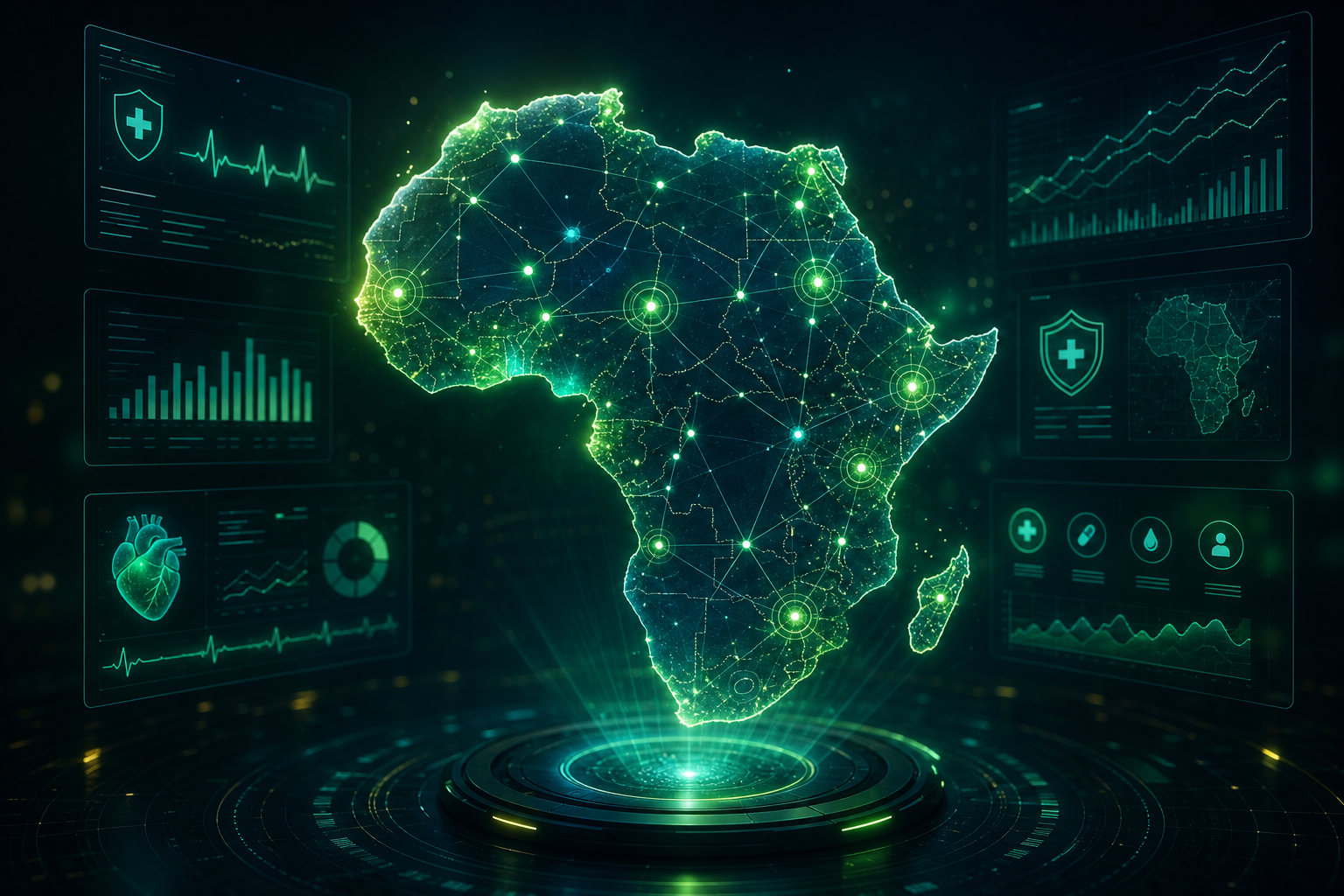
Africa Health Intelligence is the continent’s first real-time, AI-powered health systems intelligence platform. We reconstruct performance from 1950 to today, monitor operational stress monthly, and predict outbreaks before they spread. Built for ministers, planners, donors, and researchers – not as a ranking, but as a diagnostic instrument for resilience and reform.
Download Methodology SummaryAT A GLANCE
African countries
tracked
Diagnostic Domains
Real-Time Stress
Updates
Earliest Historical
Baseline
Indicators
Outbreak Prediction
Horizon
Promoted Countries

Evidence for Egypt's real-time operational stress and early warning showed a mixed and vulnerable picture. Routine surveillance systems for diseases such as influenza, COVID-19 and acute respiratory infections were in place and connected to WHO…
Evidence from Ethiopia indicated a health system under sustained but variable stress, with some effective early warning capacities but frequent localized failures. The national public health institute operated an integrated disease surveillance and event-based alert…

Evidence from 2022-2025 showed South Africa maintained functioning early warning and operational monitoring, but under uneven stress. National outbreak surveillance, including for COVID-19, influenza, cholera and measles, continued to operate with integrated laboratory reporting and…

South Africa entered the 2022-2025 period with a mature constitutional framework for health, clear national and provincial mandates, and a relatively strong culture of judicial and audit oversight. The National Health Act, National Health Insurance…
Egypt had a relatively strong formal health governance structure during the reporting period. The constitution and health laws clearly assign authority to the Ministry of Health and Population, and the Universal Health Insurance Law created…
Evidence indicated that Ethiopia had a formal legal and institutional framework for health governance, including a federal ministry, regional bureaus and multi‑year health sector strategies. National health policy and a ten‑year transformation plan defined priorities,…

Evidence from 2022-2025 showed that South Africa had relatively advanced digital health foundations compared with many African peers, but with uneven implementation and persistent fragmentation. The national Health Normative Standards Framework for interoperability, the District…
Evidence from the reporting period showed that Egypt had made substantial progress in digital health infrastructure and national data platforms, but with uneven implementation and limited interoperability at scale. The Ministry of Health and Population…
Evidence showed that Ethiopia had made structured progress in digital health and data systems but implementation remained uneven. A national information revolution roadmap and a digital health blueprint existed, alongside DHIS2 for routine data and…

Evidence from 2022-2024 showed that South Africa had one of the highest health worker densities in Africa, especially for doctors and nurses, and a large training pipeline. However, the workforce remained unevenly distributed, with major…
Evidence up to 2024 showed that Ethiopia's health workforce had expanded but remained below global benchmarks, with major imbalances between urban and rural areas and among professional categories. WHO estimated overall health worker density still…
Available evidence showed that Egypt had a growing but still insufficient health workforce relative to population needs. Physician density was above the regional average, but nurse and midwife numbers were relatively low, and many doctors…

Evidence showed that Egypt had formal climate and environmental strategies and had integrated climate risk into some health planning, especially around heatwaves, air pollution, and water scarcity. However, implementation of these plans remained uneven and…
Evidence showed that South Africa had comparatively strong environmental laws and several climate and air-quality strategies, but implementation and enforcement remained uneven. Urban air pollution from industry, power generation and transport stayed well above health…
Evidence showed that Ethiopia faced high climate and environmental health risks, especially droughts, floods, heat, land degradation, and air and water pollution. Structural plans on climate adaptation and green economy were in place, and the…
WHAT MAKES AFRICA HEALTH INTELLIGENCE DIFFERENT

Most indices show only the present. We reconstruct from 1950 - capturing colonial legacies, structural adjustment, epidemic shocks, and policy reforms. You see not just where a country is, but how it got there.

While others publish annual reports, we update monthly. Our real-time system tracks outbreaks, stock-outs, ICU occupancy, ambulance response, floods, and heatwaves - so you know when a system is about to fail.

AI pre-fills indicators, detects anomalies, and forecasts outbreaks. But final scores and alerts are always validated by country experts and epidemiologists. No black boxes.

We don't just count deaths. We measure governance, financing, workforce, supply chains, infrastructure, equity, and resilience - because outcomes follow structures.
HOW IT WORKS
Data from DHIS2, WHO, climate sensors, mobility feeds, national audits, and LMIS.
AI evaluates 22 diagnostic domains using a 0-100 scale. Human experts validate every score.
The system generates risk signals: Pandemic Readiness, Supply Chain Shock Resilience, Workforce Fragility, Out-of-Pocket Protection.
Countries receive a Diagnostic Profile, 12-36 month Risk Outlook, and Priority Reform Map.
FEATURED INTELLIGENCE SIGNALS

Are governance, finance, and delivery aligned or fragmented?

Could the country detect and contain a new outbreak?

Would global disruptions cause immediate stock-outs?

Are families being pushed into poverty by health payments?

Low Stress -> Critical Stress
(updated monthly)

Measures how fairly healthcare services are distributed across regions and populations.
Africa Health Emerging Issues & Risks
EXPLORE ANY COUNTRY
Kenya Profile Includes
WHO USES AFRICA HEALTH INTELLIGENCE
budget planning, emergency prep, reform design
fiscal risk and health spending efficiency
continental benchmarking and coordination
technical alignment
ensuring aid aligns with national priorities
longitudinal system analysis
TRUST & GOVERNANCE


no commercial sale of raw national data

governments can challenge scores with evidence

no single donor controls the platform

every indicator defined, versioned, and published

human validation is mandatory